Package ”Saxony“
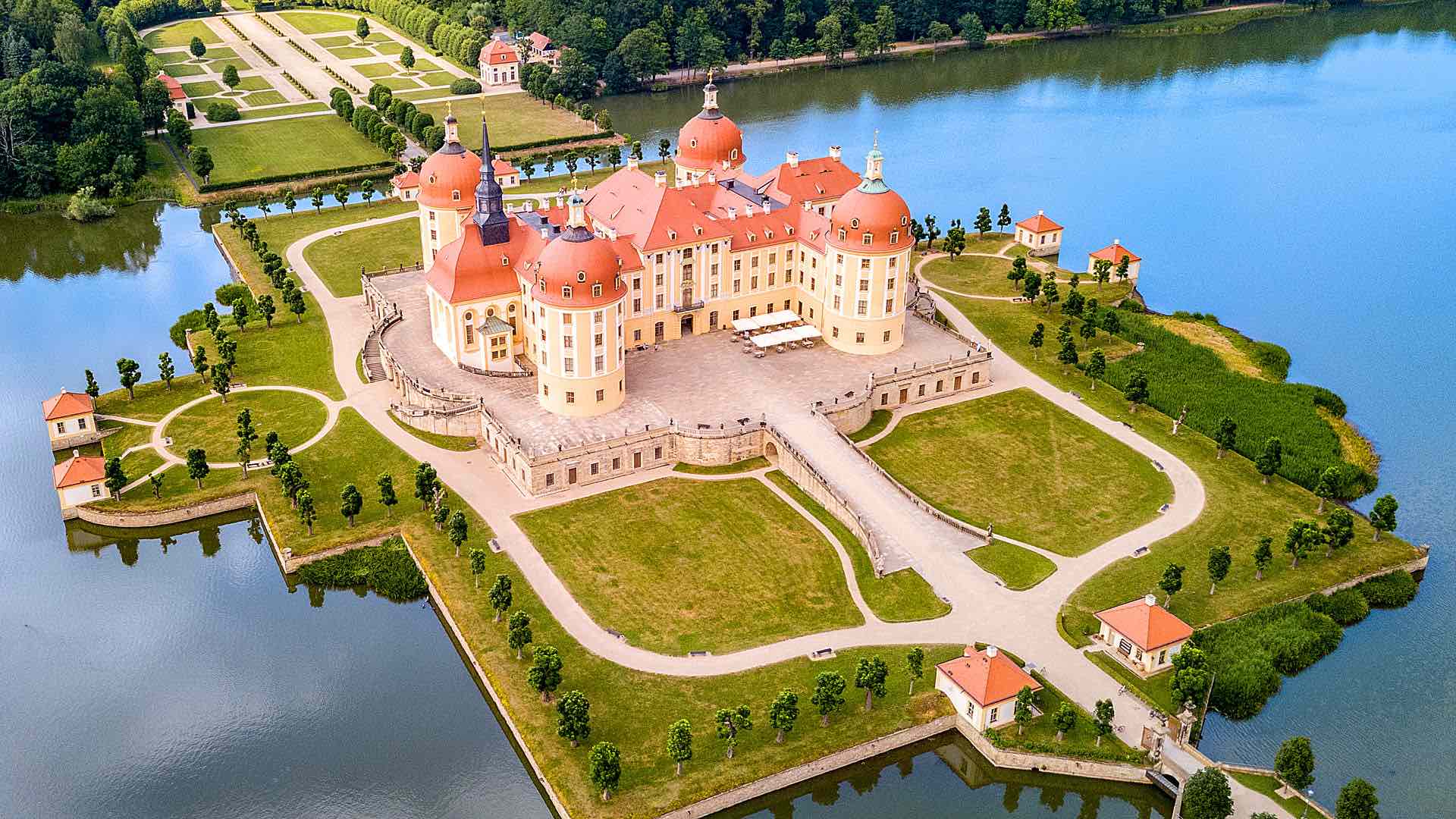
Moritzburg Castle or Moritzburg Palace is a Baroque palace in Moritzburg, in the German state of Saxony, about 13 kilometres (8.1 mi) northwest of the Saxon capital, Dresden. The castle has four round towers and lies on a symmetrical artificial island. It is named after Duke MoritzofSaxony, who had a hunting lodge built there between 1542 and 1546. The surrounding woodlands and lakes have been a favourite hunting area of the electors and kings of Saxony.
Pillnitz Palace consists of the Riverside Palace (Wasserpalais) at the river, the parallel Upper Palace (Bergpalais) towards the hills and the linking building New Palace (Neues Palais). The first two were designed by Matthäus Daniel Pöppelmann. The buildings frame the Baroque inner garden; this entire ensemble is surrounded by a park.
Pillnitz is known for the Declaration of Pillnitz of 1791: Emperor Leopold II and King Frederick William II of Prussia, urged by Charles X, then Comte d'Artois, declared that the French King Louis XVI was not to be harmed or deprived of power as a way to attack the progress of the French Revolution.
The Zwinger is a palatial complex with gardens in Dresden, Germany. Designed by architect MatthäusDanielPöppelmann, it is one of the most important buildings of the Baroqueperiod in Germany. Along with the Frauenkirche, the Zwinger is the most famous architectural monument of Dresden.
The name "Zwinger" goes back to the name used in the Middle Ages for a fortress part between the outer and inner fortress walls, even though the Zwinger no longer had a function corresponding to the name at the start of construction.